
That unpaid speeding ticket might seem like a minor nuisance now, but in New York State, ignoring a traffic violation can quickly evolve into a legal nightmare with far-reaching impacts.
Whether you’ve received a traffic ticket for exceeding the speed limit, running a traffic control signal, or another moving violation, understanding what happens if you don’t pay is crucial. Let’s explore the escalating consequences of failing to pay a New York traffic ticket and why you should act promptly to address the situation.
Introduction to Unpaid Traffic Tickets
When you receive a traffic ticket in New York, you typically have 15 days to respond by either pleading guilty and paying the fine or pleading not guilty and contesting the ticket. This timeline applies to most traffic violations issued throughout the state. If you fail to respond within this period, the consequences begin to mount quickly.
The New York State Department of Motor Vehicles (DMV) and, within New York City, the Traffic Violations Bureau (TVB) are the agencies responsible for processing traffic tickets. These organizations have significant authority to impose penalties when drivers fail to address their tickets promptly.
Ignoring a traffic ticket in New York will likely lead to a default conviction, where you’re automatically found guilty of the violation because you didn’t respond. This means you’ll face not only the original fine but also additional penalties that grow more severe over time.
Consequences of Unpaid Tickets
The most immediate consequence of failing to pay your New York traffic ticket is a significant increase in the financial burden through late fees and penalties. What might have been a manageable fine can quickly double or triple in size.
For example, if you don’t pay or answer a traffic ticket on time, the New York State DMV will impose late fees on top of the original fine. These fees continue to accumulate the longer the ticket remains unpaid.
In New York City, unpaid camera or parking violations move into “judgment” status after approximately 75 days for camera violations or 100 days for parking tickets. Once in judgment, the penalties increase sharply, and the City gains additional enforcement powers.
When fines remain unpaid, your case may be referred to a debt collection agency, which can negatively impact your credit score. This financial consequence extends far beyond the traffic violation itself, potentially affecting your ability to secure loans, rent apartments, or even obtain certain jobs.
Additionally, if you accumulate enough unpaid tickets, the city can boot or tow your vehicle once the total in judgment reaches $350 or more. This adds towing fees, storage costs, and boot removal charges to your already growing debt.
The New York State Department of Motor Vehicles may also impose a driver responsibility assessment fee for certain violations, which is a separate charge from the ticket itself. This fee is paid directly to the DMV and cannot be reduced even if you later contest the original violation.
Impact on Driving Record
Beyond the financial penalties, unpaid traffic tickets in New York State can seriously damage your driving record through the DMV’s point system. When a default conviction is entered, violation points are added to your driving record just as if you had pleaded guilty.
The New York point system assigns specific point values to different traffic violations:
· Speeding 1-10 mph over the posted limit: 3 points
· Speeding 21-30 mph over the limit: 6 points
· Running a red light or traffic control signal: 3 points
· Following too closely: 4 points
· Unauthorized racing: 5 points
· Passing a school bus: 5 points
If you accumulate 11 or more points within a 24-month period, the New York State DMV can suspend your driver’s license. Even before reaching that threshold, your driving record affects your insurance premiums, which typically increase with each point added.
A poor driving record resulting from unpaid traffic violations can also limit your employment opportunities, especially for jobs that involve driving an employer’s vehicle or require a clean driving history.
You can reduce up to 4 points on your driving record by completing a DMV-approved accident prevention course. However, this does not erase the underlying traffic violation from your record, and the points will still be counted if you accumulate additional violations within the 18-month period.
Driver’s License Suspension
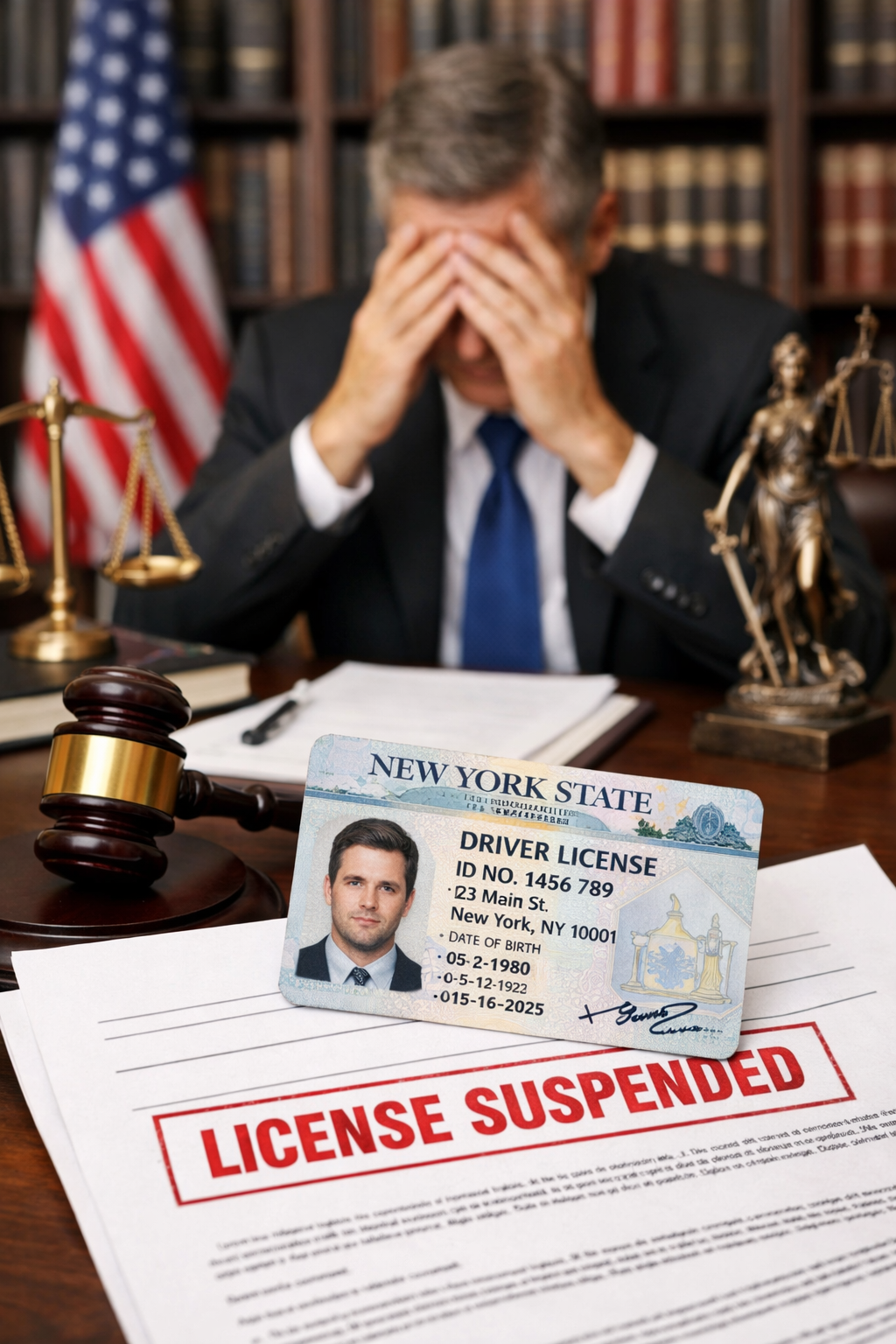
Perhaps the most disruptive consequence of failing to pay a traffic ticket is the suspension of your driver’s license by the NYS DMV. When you fail to respond to a traffic ticket or neglect to pay a fine after being found guilty, the DMV will eventually suspend your license.
A suspended driver’s license means you cannot legally drive under any circumstances. If you’re caught driving with a suspended license in New York, you face charges of Aggravated Unlicensed Operation (AUO), which is a criminal offense rather than just a traffic infraction and also carries 11 points on your license.
To reinstate your suspended driver’s license, you must:
1. Resolve all outstanding tickets by paying the fines and penalties
2. Pay a suspension termination fee (currently $70 per ticket)
3. Complete any required courses or assessments
4. Submit proper documentation to the DMV
The reinstatement process isn’t automatic—even after paying your fines, you must explicitly request reinstatement and prove you’ve satisfied all requirements. During a license probation period, any additional violations could result in further suspension or even revocation of your driving privileges.
The impact of a suspended license extends far beyond legal issues. Without the ability to drive legally, you may struggle to commute to work, take children to school, attend medical appointments, or handle everyday tasks that require transportation.
Insurance Consequences
Your auto insurance rates can skyrocket when insurance companies discover unpaid traffic violations on your driving history. Insurance providers regularly check DMV records when policies come up for renewal, and they adjust premiums based on perceived risk.
A single unpaid traffic ticket that results in points on your driving record can increase your insurance premiums by 10-30%. Multiple violations or serious infractions like reckless driving can cause rates to double or even triple.
Insurance companies view drivers with unpaid tickets and suspensions as high-risk clients. This designation can follow you for years, even after you’ve resolved the underlying tickets and reinstated your license.
For repeat offenders or those with multiple unresolved tickets, New York insurance companies may assign you to a high-risk insurance pool. These “assigned risk” policies come with substantially higher premiums and fewer benefits than standard coverage.
The financial impact of increased insurance rates often far exceeds the cost of the original traffic ticket, making it financially prudent to address violations promptly rather than allowing them to affect your insurance status.
Arrest and Warrant
In severe cases, ignoring traffic tickets can escalate to criminal charges and even arrest warrants issued by New York courts. If you repeatedly fail to respond to tickets or court summonses, a judge may issue a bench warrant for your arrest.
With an outstanding warrant, you can be arrested during any interaction with law enforcement, including routine traffic stops. This means that a simple check of your license during an unrelated stop could result in immediate arrest.
Driving with a suspended license due to unpaid traffic tickets is a criminal offense in New York called Aggravated Unlicensed Operation (AUO). Depending on the circumstances:
· Third-degree AUO is a misdemeanor punishable by fines up to $500 and potential jail time, with 11 points applied to your drivers license;
· Second-degree AUO applies to multiple suspensions and carries heavier penalties
· First-degree AUO is a felony conviction that can result in significant jail time
If you’re arrested for driving with a suspended license, your vehicle may be impounded, adding towing and storage fees to your growing list of expenses. You’ll also need to appear in court to address both the original unpaid tickets and the new criminal charges.
Given the serious nature of these consequences, it’s critical to seek legal advice if you have outstanding warrants or multiple unpaid traffic tickets. The Law Office of Gina M. Wicik can often negotiate with the court to recall warrants and establish payment plans for outstanding fines.
Hiring a Lawyer
Traffic ticket cases in New York can be complex and challenging to handle alone, especially if the situation has escalated to license suspension or warrants. The Law Office of Gina M. Wicik, can provide valuable assistance in navigating the legal system and achieving a favorable outcome.
A lawyer who practices in traffic violations can:
· Evaluate the specifics of your case
· Identify potential defenses or procedural errors
· Negotiate with prosecutors for reduced charges
· Represent you in court if you cannot appear personally
· Help establish payment plans for outstanding fines
· Work to lift license suspensions more effectively.
For complex cases involving multiple tickets or criminal charges like AUO, legal representation becomes even more critical. Attorneys familiar with New York traffic laws understand the nuances of both the Traffic Violations Bureau (which handles non-criminal traffic violations in NYC) and local courts throughout the state.
At The Law Office of Gina M. Wicik we offer a free consultation to evaluate your case and explain your options. This initial meeting can help you understand the potential consequences you face and develop a strategy for addressing unpaid tickets.
Court Representation
Having professional representation in traffic court can significantly improve your chances of a favorable outcome. Gina M Wicik can appear on your behalf at many hearings, saving you time and potentially preventing additional penalties for missing court dates.
In court, Our Lawyers can:
· Challenge the sworn testimony of the police officer who issued the ticket
· Present evidence that might reduce or dismiss charges
· Cross-examine witnesses and question the accuracy of speed detection equipment
· Negotiate plea bargains to reduce points or penalties (outside of NYC);
· Request alternative sentencing options like community service or driving courses
Court procedures vary between the Traffic Violations Bureau in NYC and local courts in other parts of New York State. The TVB doesn’t allow for plea bargaining, making representation even more valuable, our attorneys know how to work within these constraints.
If your case has already progressed to a default conviction, an attorney can sometimes file motions to vacate the judgment, essentially asking the court to reopen your case and allow you to present a defense.
Resolution of the Case
Resolving unpaid traffic tickets becomes increasingly complex the longer they remain outstanding, but solutions are available at every stage. The appropriate resolution depends on your specific situation and how far the consequences have progressed.
For relatively recent tickets, resolution may be as simple as paying the fine and any accumulated late fees. This can often be done online through the New York State DMV website or the NYC Department of Finance for city tickets.
If your license has been suspended, resolution requires:
1. Paying all outstanding fines and penalties
2. Addressing any driver responsibility assessment fees
3. Paying the suspension termination fee
4. Submitting proper documentation to the DMV
5. Waiting for official reinstatement before driving
For cases involving warrants or criminal charges, resolution typically requires court appearances and possibly negotiated settlements. The Law Office of Gina M. Wicik can often arrange for you to surrender voluntarily rather than face arrest, which looks more favorable to the court.
If financial hardship makes immediate payment impossible, payment plans are sometimes available. Your attorney can negotiate these arrangements with the court or relevant agencies.
Reinstating Driving Privileges
Once you’ve resolved all outstanding tickets and paid the required fees, you can begin the process of reinstating your driving privileges. This process isn’t automatic and requires specific steps to complete.
To reinstate a suspended driver’s license in New York:
1. Ensure all fines, penalties, and driver responsibility assessment fees are paid in full
2. Pay the suspension termination fee ($70 per suspension)
3. Submit a completed application for license reinstatement to the DMV
4. Provide proof that you’ve completed any required programs, such as a DMV-approved accident prevention course if mandated
5. Wait for processing and confirmation before driving
If you’ve accumulated too many points, you may need to complete additional requirements like the Driver Responsibility Program or a defensive driving course before reinstatement is possible.
The New York State DMV will send confirmation when your license is reinstated. Do not drive until you receive this official notification, as driving with a suspended license is a criminal offense, even if you’ve paid all outstanding fines.
For those with an expired license that was suspended, you may need to retake written and road tests before receiving a new license. Check with the DMV about your specific situation, as requirements vary based on how long your license was suspended and why.
Seeking Legal Advice
If you’re facing consequences from unpaid traffic tickets in New York, seeking legal advice is often the most prudent course of action. Our Office can review your situation, explain your options, and help develop a strategy to resolve outstanding issues while minimizing negative impacts.
Many people attempt to handle traffic tickets on their own, not realizing that legal representation can often save money in the long run by:
· Reducing or eliminating points that would increase insurance premiums
· Preventing license suspensions that impact employment
· Avoiding criminal charges that carry substantial fines and potential jail time
· Negotiating lower overall payments through plea agreements
The Law Office of Gina M. Wicik offers a free consultation to evaluate your case. During this meeting, bring any documentation related to your tickets, including the original citations if available, suspension notices, and records of any payments or correspondence with the courts or DMV.
Remember that addressing unpaid tickets becomes more difficult and expensive the longer you wait. What begins as a simple fine can evolve into a complex legal matter with serious consequences for your driving privileges, finances, and even freedom.
OUR NYC TRAFFIC ATTORNEY HAVE HELPED THOUSANDS
Failing to pay a New York traffic ticket might seem like a minor oversight, but as we’ve seen, the consequences escalate rapidly from financial penalties to potential arrest and criminal charges. The path from unpaid traffic ticket to serious legal trouble is shorter than many New York drivers realize.
When you receive a traffic ticket in New York, your best approach is to address it promptly—either by paying the fine if you committed the violation or contesting it properly if you believe you’re not guilty. Ignoring the ticket won’t make it disappear; instead, it transforms a simple traffic infraction into a cascade of increasingly severe consequences.
If you already have unpaid tickets, don’t wait until your license is suspended or a warrant is issued to take action. Remember, every day that passes with an unpaid traffic ticket brings you closer to more serious consequences. Act promptly to protect your driving privileges, financial stability, and peace of mind. Contact The Law Office of Gina M. Wicik for a free consultation, 516-253-4278.