By Law Office of Gina M. Wicik
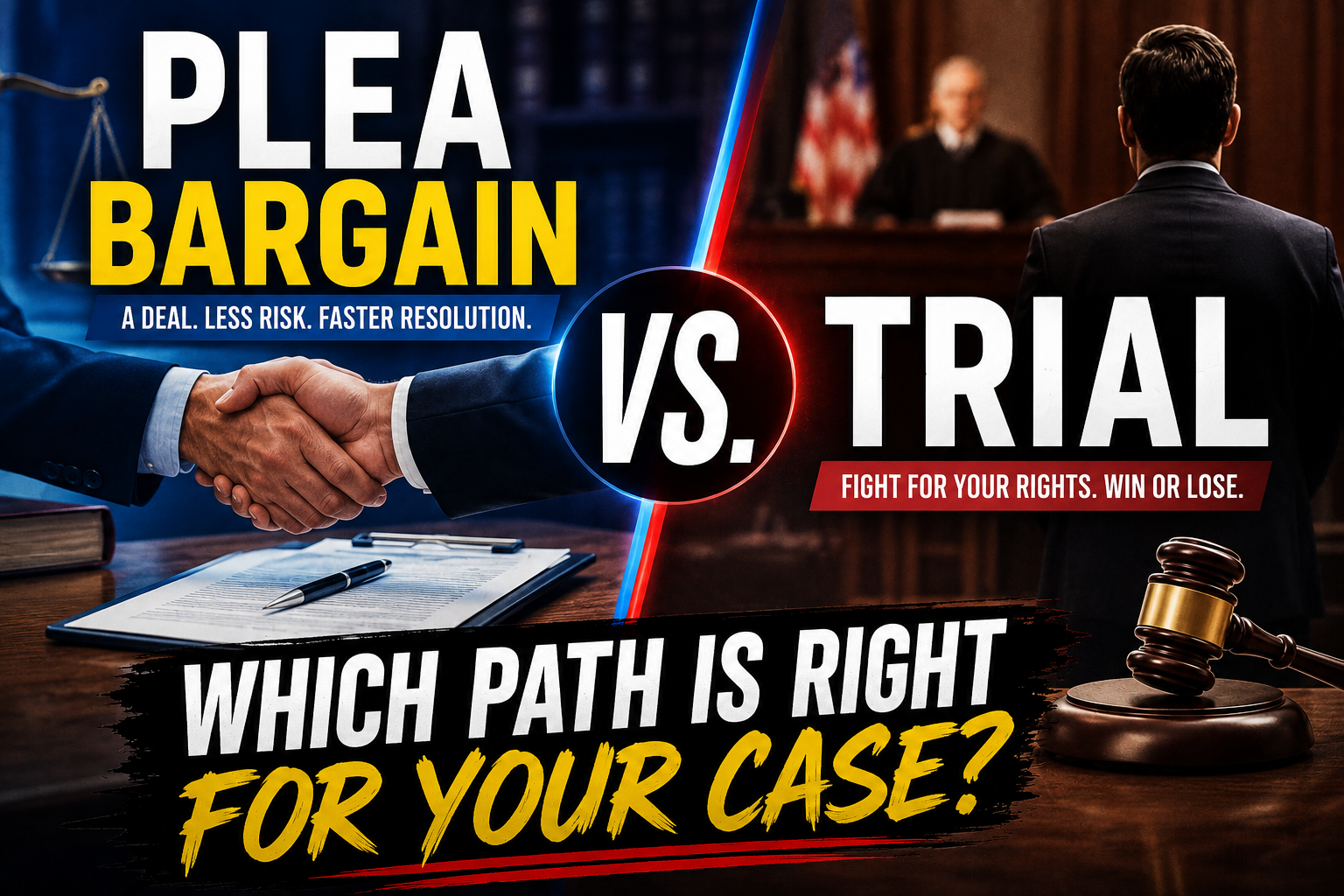
There is no one-size-fits-all answer. Every case is unique, and the best strategy depends on the evidence, the charges, your criminal history, and your personal goals.
Understanding the differences between a plea bargain and a trial can help you make an informed decision and protect your future.
What Is a Plea Bargain?
A plea bargain is an agreement between the defendant and the prosecutor to resolve a criminal case without a trial. In exchange for pleading guilty to one or more charges, the prosecutor may agree to:
- Reduce the charges
- Recommend a lighter sentence
- Dismiss certain charges
- Agree to probation instead of jail
- Recommend community service or treatment programs
Once approved by the judge, the case is resolved without a trial.
What Is a Criminal Trial?
A criminal trial is a formal court proceeding where the prosecution must prove the defendant’s guilt beyond a reasonable doubt.
Depending on the case, the trial may be decided by:
- A judge (bench trial), or
- A jury of your peers (jury trial)
During the trial, both sides may:
- Present evidence
- Cross-examine witnesses
- Challenge the opposing side’s evidence
- Make legal arguments
- Deliver opening and closing statements
The judge or jury then determines whether the prosecution has proven the charges.
Plea Bargain vs. Trial: Key Differences
| Plea Bargain | Trial |
|---|---|
| Faster resolution | May take months or longer |
| Usually less expensive | Often higher legal costs |
| Outcome is negotiated | Outcome is uncertain |
| May reduce penalties | Possibility of complete acquittal |
| Avoids trial stress | Public court proceeding |
| Waives many appeal rights | Greater opportunity for appellate review |
Advantages of Accepting a Plea Bargain
Depending on the facts, a plea agreement may offer significant benefits.
Reduced Penalties
Many plea agreements result in:
- Reduced charges
- Lower fines
- Shorter probation
- Avoiding incarceration
- Reduced driver’s license consequences (where applicable)
Certainty
A negotiated resolution provides a known outcome rather than risking a conviction after trial.
Faster Resolution
Trials often require multiple court appearances and may be delayed for months. Plea agreements can resolve a case much sooner.
Reduced Stress
Many clients prefer avoiding the uncertainty and emotional strain associated with trial.
Advantages of Going to Trial
A trial may be the better option when there are strong legal or factual defenses.
Opportunity for an Acquittal
If the prosecution cannot prove every element of the offense beyond a reasonable doubt, you may be found not guilty.
Challenge Weak Evidence
Your attorney may challenge:
- Illegal searches
- Improper police procedures
- Eyewitness identification
- Scientific evidence
- Credibility of witnesses
- Constitutional violations
Protect Your Rights
Going to trial allows the prosecution’s evidence to be fully tested in court.
Factors to Consider Before Accepting a Plea Deal
Every case should be carefully evaluated before making a decision.
Important considerations include:
- Strength of the prosecution’s evidence
- Availability of legal defenses
- Seriousness of the charges
- Potential sentence if convicted
- Criminal history
- Immigration consequences
- Professional licensing concerns
- Employment implications
- Driver’s license consequences
- Personal goals and risk tolerance
Can You Reject a Plea Bargain?
Yes.
You are generally not required to accept a plea offer. If you reject it, the case may proceed through additional negotiations or move toward trial.
In some cases, prosecutors may extend new plea offers later in the process, while in others the original offer may expire.
Does Every Criminal Case End in Trial?
No.
The vast majority of criminal cases are resolved before trial through dismissals, negotiated plea agreements, diversion programs, or other resolutions. However, when a fair resolution cannot be reached—or when the evidence supports a strong defense—taking a case to trial may be the best course of action.
Why You Should Never Decide Alone
Choosing between a plea bargain and a trial is one of the most important decisions in any criminal case.
An experienced criminal defense attorney can:
- Review the evidence
- Identify constitutional issues
- Evaluate the strengths and weaknesses of the prosecution’s case
- Explain potential outcomes
- Negotiate with prosecutors
- Prepare your case for trial if necessary
The right legal strategy depends on the specific facts of your case—not a general rule.
Frequently Asked Questions
Is a plea bargain an admission of guilt?
Generally, yes. A plea bargain typically involves pleading guilty to one or more charges in exchange for negotiated terms.
Can a plea bargain reduce jail time?
Yes. In many cases, prosecutors may agree to recommend reduced penalties or alternatives to incarceration.
What happens if I lose at trial?
If convicted, the court may impose the sentence authorized by law. The specific penalties depend on the offense and the facts of the case.
Is trial always the better choice?
Not necessarily. Some cases are well suited for trial, while others may be resolved more favorably through negotiation.
Should I accept the prosecutor’s first plea offer?
Not always. Every offer should be reviewed with an experienced criminal defense attorney before making a decision.
Contact an Experienced Criminal Defense Attorney
If you are facing criminal charges in New York or New Jersey, the decision between accepting a plea bargain and taking your case to trial should never be made without experienced legal guidance.
At the Law Office of Gina M. Wicik, we carefully evaluate every case, negotiate aggressively with prosecutors, and are fully prepared to take cases to trial when necessary to protect our clients’ rights.
📞 Call today for a FREE consultation: (516) 253-4278
Contact us online:
https://wiciklaw.com/contact-us/
Related Articles
- Criminal Court vs. Traffic Violations Bureau (TVB)
- What Happens After an Arrest?
- Misdemeanor vs. Felony
- Can Criminal Charges Be Dismissed?
- What Is a Grand Jury?
- New York Criminal Defense Lawyer
- New Jersey Criminal Defense Lawyer
- DWI Defense in New York
- DWI Defense in New Jersey
The Law Office of Gina M. Wicik proudly represents clients throughout New York and New Jersey, providing strategic, aggressive, and personalized criminal defense representation from the initial investigation through trial.